



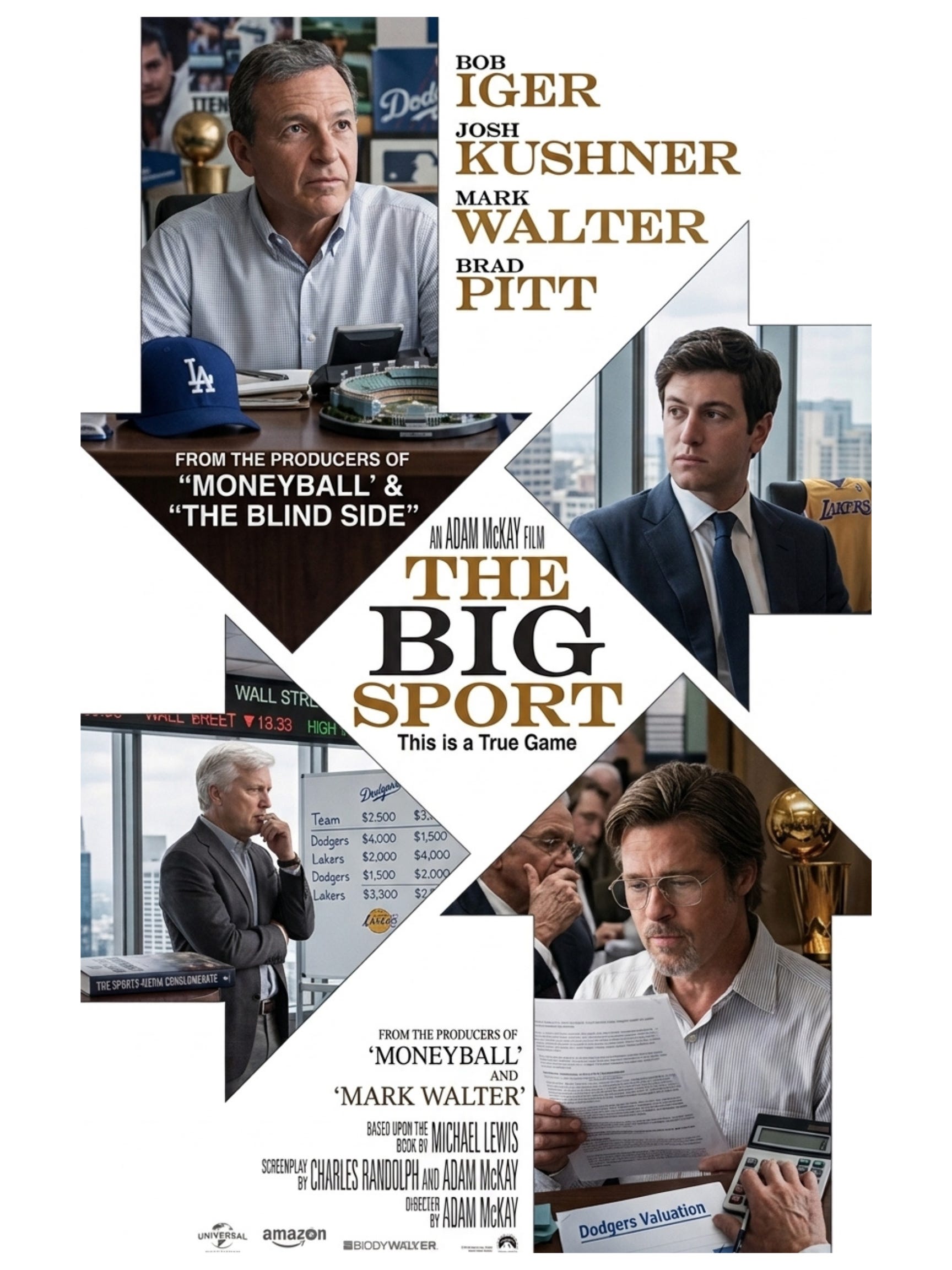
Somewhere out there is a Michael Burry type staring at a spreadsheet, doing the math on the Los Angeles Lakers, and quietly losing his mind. This week Mark Walter agreed to sell the Lakers to Josh Kushner and Bob Iger for a record $12.5 billion, the most anyone has ever paid for an American sports team. Here is the detail that turns a sports story into a finance horror movie: Walter bought the Lakers 14 months ago for $10 billion. He is flipping them for a $2.5 billion profit before he has finished unpacking. That is not owning a basketball team. That is a real estate flip on a franchise, and it happened faster than most people repaint a kitchen.
If you have seen The Big Short, you know the shape of this. A number gets so detached from the thing underneath it that a few people start asking the only sane question, which is: what is this actually worth? The Lakers generate a few hundred million a year in revenue and just sold for twelve and a half billion, a multiple that would get laughed out of any other boardroom on earth. And the tell, the part Steve Carell would be yelling about in a strip club, is why Walter is selling at all, because the man is not just the Lakers guy.
He also owns the Dodgers, the most expensive roster in baseball, a team built on a mountain of deferred contracts. Shohei Ohtani deferred $680 million of his $700 million deal, and the Dodgers owe roughly a billion in deferred money to Ohtani, Betts, and Freeman that does not come due until the 2040s. Here is where it knots together. The Los Angeles Times reported that most of the money Walter used to buy the Dodgers, more than a billion dollars, came from insurance companies he controls through Guggenheim. Two of those insurers, Delaware Life and Clear Spring, are now under federal grand jury subpoena, part of an SEC and DOJ probe, sparked by a whistleblower, into how Guggenheim disclosed billions in loans. To be clear, the Dodgers’ deferrals are legal under the league’s rules, and Walter has not been charged with anything. But you can see the shape people are squinting at: trophy assets bought with insurance money, enormous obligations pushed decades into the future, and federal investigators now pulling the thread. It seems the whole empire runs on the same balance sheet, and the man at the top just chose this exact moment to sell his shiniest asset at the highest price in history and raise a pile of cash.
The difference between the housing bubble and the sports bubble is the punchline: you cannot short a basketball team. There is no put option on the Lakers, no credit default swap on the Knicks, no way to bet against a franchise valuation no matter how insane it gets. The bubble is un-shortable, which is exactly why it never pops. When the only buyers are billionaires collecting toys and the only exit is selling to a bigger billionaire, the number just goes up forever, powered by ego, which has never once been margin-called. So we cannot short the Lakers. But we can look at what $12.5 billion actually buys. To the board.
TRADE 1: Los Angeles Lakers to Win the 2027 NBA Championship
Here is what the most expensive asset in the history of American sports gets you on the floor. The Lakers, freshly valued at $12.5 billion, are priced around 28-to-1 to actually win the 2027 title, a roughly 3 to 4% chance that leaves them outside the league’s entire top tier. Read that gap again. Kushner and Iger paid a world-record sum for a team the market gives a 1-in-30 shot at a trophy. That is the whole Big Short thesis in one line: price and value have completely uncoupled. You are not buying a contender, you are buying a logo, a city, a Luka Dončić highlight reel, and the right to sit courtside while the Oklahoma City Thunder win the actual games. The roster is fine. The number on the franchise is science fiction. If the Lakers were a stock, the valuation would imply a dynasty. The betting market implies a second-round exit. Both things are true at once, which is precisely how you know you are looking at a bubble nobody can pop.
TRADE 2: Los Angeles Dodgers to Win the 2026 World Series
Here is the other half of the Walter empire, and it is winning. The Dodgers sit at 37% to win the 2026 World Series, the runaway favorite in a 30-team field, with the next closest team at 10% and nearly $39 million traded. This is the bubble that pays off, for now. Los Angeles chases a third straight title on the back of the most leveraged roster in sports, a lineup financed by pushing roughly a billion dollars in salary into the 2040s, then reinforced at the deadline by trading for reigning Cy Young winner Tarik Skubal because a team that defers everything always has room for one more arm. It is a genuinely great baseball team. It is also the clearest picture of the whole Big Short thesis in cleats: win now, pay later, and let future-you sort out the bill. The Lakers were the trophy Walter sold at the top. The Dodgers are the one still generating championships on borrowed time, literally, with the deferred money coming due long after the banners are hung. The market says 37%, best in baseball. The question the open raises is who exactly is holding the paper when those deferrals finally land, and whether the same insurance companies now under subpoena are anywhere near the answer.
TRADE 3: Nothing Ever Happens: 2026
And here is the market that ties the whole thing together, the closest thing Polymarket has to the calm before Carell starts screaming. “Nothing Ever Happens: 2026” prices an 81% chance that this year ends without a single paradigm-shifting global event, no crash, no war escalation, no collapse, nothing. Eighty-one percent says the good times roll on undisturbed. That is the exact sentiment that priced every bubble in history right up until the morning it did not. The crowd is overwhelmingly confident that nothing breaks, while the smartest money in sports quietly sells its trophy asset to a bigger fool and raises cash ahead of a federal probe. In The Big Short, the whole system was 81% sure nothing would happen too. The market is almost always right that nothing happens, which is what makes the rare morning it is wrong so expensive. Buy the calm if you believe it. Just know you are on the same side of the trade as everyone who has ever said the number only goes up.
About The Spread Sheet
Your comedic entry into what is trending on prediction markets. Hosted by Noah Gardenswartz. Each week Noah and a guest take the questions the markets are actually pricing, across sports, pop culture, power and tech, and call them. We explain them. We make fun of them. Then we give the verdict: YES or NO.
Follow
Web: spreadsheetshow.com
X: x.com/spreadsheetshow
Instagram: instagram.com/spreadsheetshow
TikTok: tiktok.com/@spreadsheetshow
YouTube: youtube.com/@spreadsheetshow
Disclosures
Not financial advice. Prediction markets discussed for entertainment and editorial purposes. Trade at your own risk and verify all odds independently.